 Comparison
7 Concrete vs Pavers Pros and Cons Contractors See
Last Updated: November 24, 2026
Quick Summary
The pros and cons of concrete vs pavers come down to upfront cost, repairability, freeze-thaw resilience, and design flexibility. Concrete wins on initial price and speed, while pavers win on longevity, repair, and curb appeal. The right pick depends on how your site drains and how you want the space to age.
- Poured concrete carries the lower upfront cost, but a surface that cracks early can cost more over time.
- A damaged paver lifts out and resets individually, while a cracked slab needs section replacement or resurfacing.
- Pavers flex with ground movement and drain through their joints, which helps them handle freeze-thaw cycles.
- Stamped concrete color sits near the surface and depends on sealer, so it can fade unevenly.
- Keep paver joints topped off with polymeric joint sand and maintain edge restraint to limit weeds and ants.
Table of Contents
- What Are the Pros and Cons of Concrete vs Pavers?
- Pavers vs Concrete Cost per Square Foot
- Pavers vs Concrete Driveway: Which Holds Up?
- Stamped Concrete vs Pavers: Design and Durability
- Paver Patio Pros and Cons for Outdoor Living Spaces
- Installation, Drainage, and Freeze-Thaw Performance
- Weed and Pest Management in Concrete vs Pavers
- Request a Free Quote from Santini's Landscape
- Frequently Asked Questions
What Are the Pros and Cons of Concrete vs Pavers?
The pros and cons of concrete vs pavers come down to four trade-offs: upfront cost, repairability, freeze-thaw resilience, and design flexibility. Concrete wins on initial price and speed; pavers win on longevity, repair, and curb appeal. At Santini's Landscape, we install both, and the right pick depends on how your site drains and how you want the space to age. Dreams Set in Stone starts with that honest comparison, not a sales pitch.
Here is the short version before we get into the details:
| Factor | Poured Concrete | Pavers |
|---|---|---|
| Upfront cost | Lower | Higher |
| Repair after damage | Patch or replace slab section | Lift and reset individual units |
| Freeze-thaw behavior | Prone to cracking without control joints | Flexes with ground movement |
| Design options | Limited unless stamped | Wide range of shapes and colors |
| Long-term maintenance | Sealing, crack repair | Joint sand refresh, occasional reset |
A common mistake is choosing on price alone, since a surface that cracks early can cost more over time than one that lasts longer.
Pavers vs Concrete Cost per Square Foot
Poured concrete is generally the lower upfront cost of the two materials, and the cost of each option depends on the project. But the number a homeowner sees quoted is not a single line item, it is the sum of several cost drivers that behave very differently between the two materials. Understanding those drivers is how you compare bids honestly instead of comparing totals.
What drives poured concrete cost:
- Base preparation. Excavation, grading, and compacted aggregate are required for both materials, but a slab needs a uniform, stable subgrade because the whole surface shares the load.
- Formwork and reinforcement. Wood or metal forms outline the pour, and rebar or mesh controls cracking. Both are labor and material costs that scale with the slab's perimeter and thickness.
- One continuous pour. Concrete arrives by truck, gets placed, screeded, floated, and finished in a single mobilization. That speed is the main reason the upfront number is lower.
- Control joints and curing. Joints must be cut at the right spacing and the slab must cure under controlled conditions. Rushing either step is where future cracks begin.
What drives paver cost:
- Deeper base excavation. A paver system carries load through a compacted aggregate base, bedding layer, and edge restraint, so excavation depth and base volume are typically greater than a slab's.
- Unit count and hand labor. Every paver is set, leveled, and compacted by hand or with plate compactors. More units and more pattern complexity mean more labor hours.
- Edge restraint. A paver field without a locked edge will spread. The restraint is a small line item with an outsized effect on longevity.
- Joint sand and compaction passes. Polymeric joint sand and multiple compaction cycles add material and time.
A concrete slab that cracks may need section replacement or resurfacing; a paver field lets a single damaged unit be lifted and reset without touching the rest.
Pricing depends on square footage, site access, base conditions, and material selection, so we quote each project individually. For a realistic budget anchor before you commit, see our guide to the cost of custom patio installation.
Pavers vs Concrete Driveway: Which Holds Up?
In cold climates, pavers are often considered a durable option under vehicle loads and ground movement. A concrete driveway is a rigid slab. When the sub-base shifts or a freeze-thaw cycle lifts a section, the slab cracks because it has nowhere to flex.
Pavers are interlocking units laid over a compacted aggregate base. Each unit moves slightly with the ground and returns to position. A settled or cracked area gets lifted, re-leveled, and reset.
Neither surface is maintenance-free. Concrete needs joint control and sealing. Pavers need joint sand and a stable edge restraint. The difference is what happens after damage: a paver repair is local, a slab repair is not. Our guide to preventing patio settling and cracking explains how base prep decides which failure you get.
Stamped Concrete vs Pavers: Design and Durability
Stamped concrete vs pavers is where design ambition meets durability, and the two materials achieve a similar look through completely different mechanisms. Knowing how each one gets its pattern explains why they age differently.
How stamped concrete gets its look:
- Stamping timing. The pattern is pressed into the slab while the concrete is still plastic, using textured mats or stamps. If the concrete sets too far or not enough, the imprint depth and crispness suffer.
- Release agents and color hardeners. Surface color is broadcast or applied, and release agents keep stamps from sticking. The color sits at or near the surface rather than running through the slab.
- Sealer dependence. A sealer locks in the color and protects the surface. As the sealer wears under traffic and sun, color can fade unevenly, and re-sealing becomes a recurring task.
- One rigid surface. The pattern is a finish on a structural slab. Any crack that opens runs straight through the design, and a repair patch rarely matches the surrounding stamp pattern.
How pavers get their look:
- Unit-to-unit variation. Color blends, surface textures, and size mixes are manufactured into the units, so variation is inherent rather than applied.
- Through-body color. Pigment runs through the paver body, so chips and wear reveal the same color rather than a contrasting core.
- Pattern by layout. Running bond, herringbone, basketweave, and borders are created by how units are laid, not by a stamp. Curves and irregular edges are cut to fit.
- Replaceable surface. A damaged unit lifts out and a matching one goes in. The pattern survives the repair.
Durability separates them further. Stamped concrete is a coating-level finish on a structural slab; the slab still has to resist freeze-thaw movement and sub-base settlement on its own. Pavers are the structure, the base, edge restraint, and joint sand do the load-bearing work, and the surface is replaceable piece by piece. That is why a paver field can outlast a stamped slab even though the stamped slab looked convincing on day one.
Paver Patio Pros and Cons for Outdoor Living Spaces
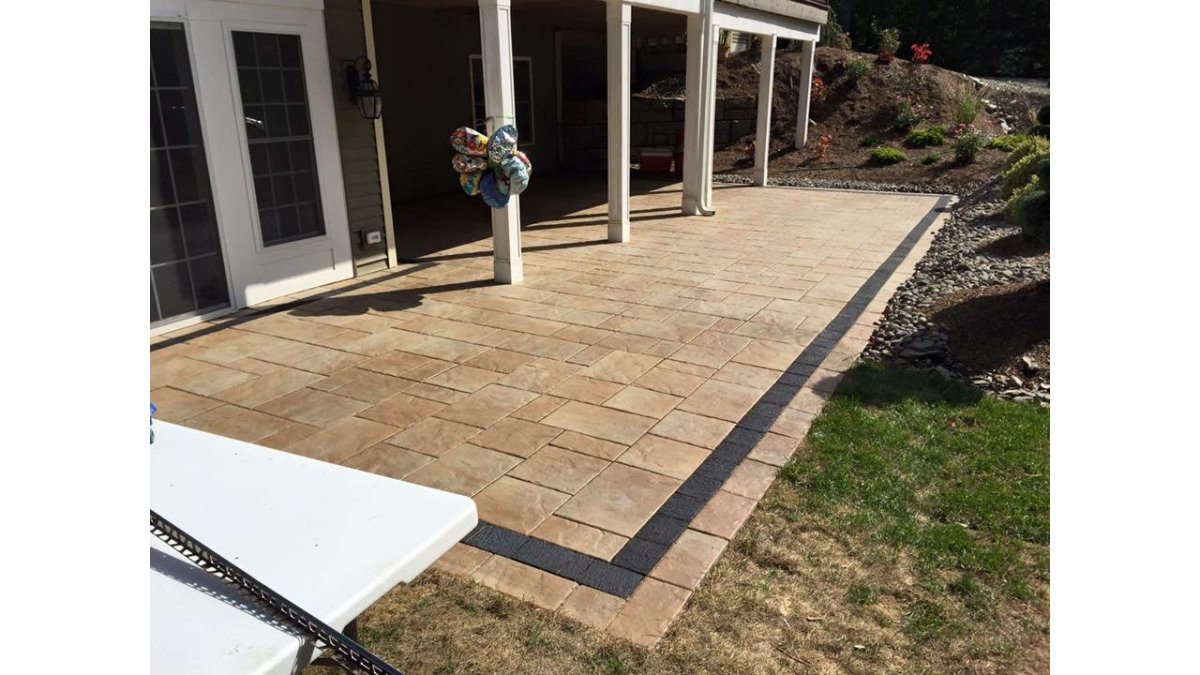
A paver patio is the stronger choice for an outdoor living space you plan to use hard and reconfigure over time. The pros: repairability, design range, permeability when specified, and a surface that handles freeze-thaw movement. The cons: higher upfront cost and joint sand that needs periodic refreshing.
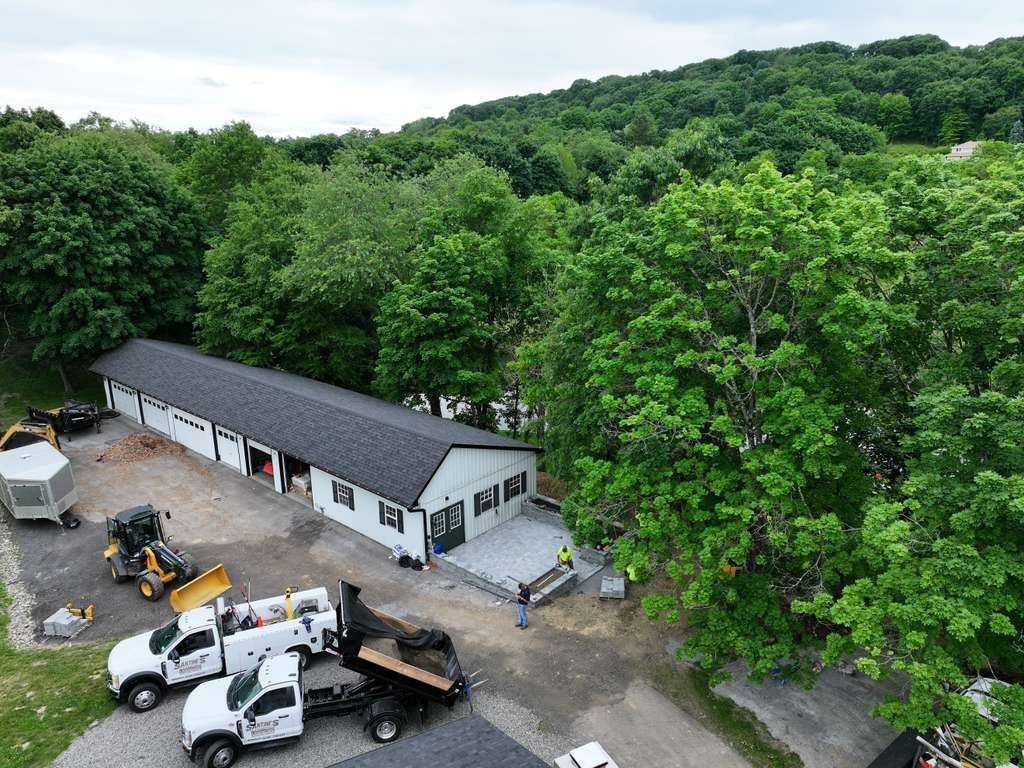
For patios, the practical advantages stack up:
- Repair without demolition. A cracked or settled paver lifts out and resets.
- Design flexibility. Curves, borders, and mixed sizes are laid to fit, not formed.
- Drainage control. Permeable joints and proper slope move water off the surface.
- Resale appeal. Curb appeal and a surface that reads as premium.
The honest drawback is cost and the discipline of maintenance. If you want to know how long the investment actually lasts, read how long a paver patio lasts.
Installation, Drainage, and Freeze-Thaw Performance
Installation, drainage, and freeze-thaw performance decide whether either surface survives a Hudson Valley winter. Concrete is poured over a prepared base with control joints cut to direct cracking. Pavers are set over a compacted aggregate sub-base with joint sand and edge restraint.
Freeze-thaw cycles are the real test. Water that gets under a rigid slab and freezes will heave and crack it. A properly built paver system drains through its joints and flexes with minor movement instead of fighting it. Sub-base preparation is the whole game in both cases: bad base, bad surface, every time.
Watch out: skipping excavation depth or drainage slope to save on labor is the single most common cause of settling and heaving we correct. If durability under freeze-thaw is your priority, our breakdown of durable hardscape materials covers which surfaces hold up best.
Weed and Pest Management in Concrete vs Pavers
Weed and pest management in concrete vs pavers favors concrete on the surface and pavers on repairability. A continuous slab has few joints for weeds to exploit. Pavers have many joints, and joint sand is where weeds and ants take hold if the sand is not maintained.
The fix is straightforward:
- Keep joints topped off with polymeric joint sand.
- Maintain a stable edge restraint so units do not shift and open gaps.
- Re-sand after cleaning, not just when weeds appear.
- Address poor drainage, which keeps joints damp and inviting.
Concrete is not immune. Cracks and control joints collect soil and sprout weeds too. The difference is that a paver joint is designed to be refilled, while a concrete crack is a repair. Our guide to preventing patio pavers from shifting covers the joint and edge details that keep weeds out.
Request a Free Quote from Santini's Landscape
Choosing between concrete and pavers is a decision about how your site drains, how the surface will age, and how much repair you want to face in ten years. We install both, and we focus on one project at a time so every detail gets attention. You Need Santini's when the comparison stops being theoretical and the ground gets opened.
We bring premium materials, specialized equipment, and a team that has been at this since 2004.
Get started with Santini's Landscape and build an outdoor space that holds up through every freeze-thaw cycle.
Ready to settle concrete vs pavers for your property? Request a free quote and we will walk your site, talk through drainage, and give you a straight comparison for your budget.
Frequently Asked Questions
Is it cheaper to put down pavers or pour concrete?
Poured concrete is generally the lower upfront cost of the two materials. Pavers require a compacted sub-base, joint sand, and more hands-on installation time. However, the gap narrows over the life of the surface: concrete can crack and need patching or resurfacing, while individual pavers can be lifted and replaced. In a freeze-thaw climate, repairability often matters more than the initial number. Request a free quote from Santini's Landscape for a comparison based on your site.
Which lasts longer, concrete or pavers?
Both can last decades when installed over a properly prepared sub-base. Poured concrete is a single slab, so a crack can spread and is difficult to repair invisibly. Pavers are interlocking units that flex slightly with the ground and can be removed and reset if settling or heaving occurs. In regions with freeze-thaw cycles, that repairability gives pavers an edge for long-term performance. Sealing and joint sand maintenance also affect how well either surface ages.
Are pavers easier to repair than poured concrete?
Yes. A damaged paver can be lifted, the bedding layer re-leveled, and the unit replaced without touching the rest of the patio or driveway. Poured concrete repairs usually mean patching a crack or resurfacing the whole slab, and color matching is difficult. For driveways and patios that see heavy use or soil movement, that difference in repairability is one of the strongest arguments for pavers.
What is the difference between stamped concrete and pavers?
Stamped concrete is a single poured slab with a pattern pressed into the surface and colored to mimic stone or brick. It offers design flexibility at a lower upfront cost than pavers. Pavers are individual units set on a compacted base with joint sand between them, so they can move slightly and be replaced individually. Stamped concrete can crack like any slab, and matching a repair is difficult. Pavers cost more initially but are easier to maintain and repair over time.