 how-to
Retaining Wall Drainage Pipe: Step-by-Step Install
Last Updated: October 27, 2026
Quick Summary
To install a retaining wall drainage pipe, dig a trench along the back of the footing, line it with filter fabric, and set perforated pipe with holes facing down. Grade the pipe about 1 inch per 10 feet toward the outlet, cover it with 3/4-inch clean gravel, wrap the fabric over the top, and test water flow before backfilling.
- Dig the trench roughly 12 inches wide and 12 to 18 inches deep so the pipe sits below the base course.
- Overlap geotextile seams by several inches and fold the fabric back over the gravel before backfilling.
- Check pipe slope with a level and string line before burying anything.
- Install a cleanout at the high end of the run and at any significant bend.
- A daylight outlet must sit lower than the lowest point of the drain pipe.
Table of Contents
- Why Water Behind a Wall Brings It Down
- How to Install Drain Pipe Behind a Retaining Wall
- Perforated Pipe Selection and Slot Orientation
- Retaining Wall Drain Pipe Slope and Grading
- Geotextile Fabric for Retaining Wall Drainage
- Retaining Wall Drainage Outlet and Discharge
- Retrofitting Drainage Into an Existing Wall
- Common Mistakes We Fix on Failed Walls
- Frequently Asked Questions
Why Water Behind a Wall Brings It Down
Most failed retaining walls don't collapse because the stone was wrong. They fail because water had nowhere to go. The block can look fine for a season, then a heavy rain pushes it out of plumb. Understanding what water does behind a wall is an important part of planning drainage.
Hydrostatic Pressure and Wall Stability
Hydrostatic pressure is the force saturated soil and trapped water push against the back of a wall. Wet soil weighs far more than dry soil, and when water can't drain, that pressure builds until the wall leans, cracks, or bulges. A retaining wall drainage system releases that pressure before it does damage. No drainage means the wall fights the water alone, and water usually wins.
What You'll Need Before You Dig
Gather your materials and tools first. Digging twice is the most common time-waster on these jobs.
- Perforated drain pipe, 4-inch PVC or corrugated
- Crushed stone or gravel, 3/4-inch clean
- Geotextile filter fabric
- Drainage outlet fittings
- Shovel, wheelbarrow, and hand tamper
- Level and string line
- Work gloves and safety glasses
One call before you dig: contact your state's 811 utility locate service (811 Before You Dig). Hitting a gas or power line is a real risk, and it's free to check.
How to Install Drain Pipe Behind a Retaining Wall
How to install drain pipe behind a retaining wall comes down to a fixed order: excavate the trench, line it with fabric, set and grade the pipe, add gravel, wrap the fabric, then test before backfilling.
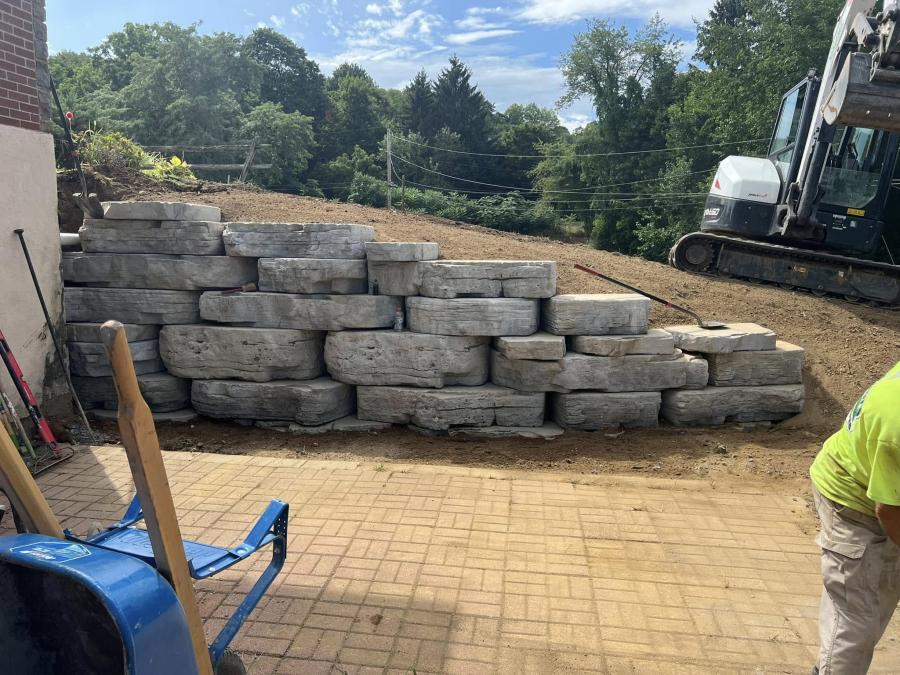
Step 1: Excavate the Trench Along the Footing
Dig a trench along the back of the wall footing, on the soil side. Keep it wide enough to fit the pipe plus gravel on all sides, a common target is roughly 12 inches wide and 12 to 18 inches deep, deep enough that the pipe sits below the wall's base course. Run the trench the full length of the wall and slope it slightly downhill toward your outlet. For larger walls or heavy clay soil, a machine does this faster than a shovel. See our excavation service to book help with the dig.
Step 2: Line the Trench With Filter Fabric
Roll non-woven geotextile along the trench so it covers the bottom and both sides, with enough overhang to fold back over the gravel later. Overlap seams by several inches. The fabric is the barrier that keeps fine soil from migrating into the stone and killing the drain.
Step 3: Set the Pipe and Establish Slope
Set the perforated pipe with the holes facing down, and grade it to a steady fall toward the outlet, about 1 inch per 10 feet is a common target. Check the slope with a level and string line before you bury anything. A flat or back-sloped pipe fills with silt and stops draining, which defeats the whole system.
Step 4: Add Gravel Backfill
Cover the pipe with clean, 3/4-inch crushed stone. This gravel layer is the drainage core: water flows through it, into the pipe, and away from the wall. Keep the stone clean, fines and dirt in the aggregate clog the system before it ever starts working.
Step 5: Wrap the Fabric and Test Before Backfilling
Fold the fabric over the top of the gravel so soil can't wash in, overlapping the seams. Before you backfill, run water through the pipe and confirm it flows freely to the outlet. Testing now is cheap; re-excavating later is not. Once flow is confirmed, backfill in lifts and compact as the wall design requires.
Wall-Specific Variations
The sequence and details can vary by wall type and site conditions. Dreams Set in Stone.
Perforated Pipe Selection and Slot Orientation
Perforated pipe selection matters more than most people think.
Retaining Wall Drain Pipe Slope and Grading
Retaining wall drain pipe slope should let water flow by gravity, never sit. A steady fall toward the outlet is a common target. Check the slope with a level and string line before you bury anything. A flat or back-sloped pipe fills with silt and stops draining, which defeats the whole system.
Geotextile Fabric for Retaining Wall Drainage
Geotextile fabric for retaining wall drainage is the barrier that keeps the system alive. It wraps the gravel so fine soil can't migrate in and clog the stone. Fabric on the soil side and over the top of the gravel keeps sediment out while letting water pass through.
Retaining Wall Drainage Outlet and Discharge
A drainage system only works if the water has a safe place to go. A drainage system needs a suitable place for water to go.
Daylight Outlets
A daylight outlet is the simplest and most reliable: the pipe exits at grade on a downhill slope and water runs away by gravity. The exit point must be lower than the lowest point of the drain pipe, or water backs up. Protect the exit with riprap or a splash block so the discharge doesn't erode the soil around it.
Pop-Up Emitters and Dry Wells
Where a daylight outlet isn't possible, a pop-up emitter releases water at the surface and closes when flow stops to keep debris out. A dry well, a gravel-filled pit, stores and slowly releases water into the soil. Both need to be sized for the volume the wall drains, and both need a cleanout upstream so you can flush the line.
Cleanouts
Install a cleanout at the high end of the run and at any significant bend. A cleanout lets you flush sediment before it plugs the pipe, and it's the difference between a drain that lasts decades and one that fails in a few seasons.
Discharge Rules
For the full picture on where water should end up, see our guide to backyard drainage solutions. You Need Santini's.
Retrofitting Drainage Into an Existing Wall
An existing wall with no drainage can often be saved without tearing it down. The trick is working from the top: dig down behind the wall, tuck fabric and gravel in, and set pipe as deep as the wall allows. It's slower and tighter than a new build, but it relieves pressure. When a wall is already leaning or cracking, though, retrofit alone won't fix it. That's when it's time to contact us for an assessment before the damage spreads.
Common Mistakes We Fix on Failed Walls
Watch for these potential issues on your own project:
| Mistake | What Happens | The Fix |
|---|---|---|
| No drain pipe at all | Water pressure bulges the wall | Add perforated pipe and gravel |
| Slots facing up | Pipe clogs with soil | Turn slots down |
| No filter fabric | Gravel fills with sediment | Wrap with geotextile |
| Flat pipe | Water sits and silts up | Re-grade to a steady fall |
| Poor outlet | Water pools at the wall | Route to a safe discharge |
If you're seeing warning signs, consider what may need attention. For the bigger build picture, our retaining wall construction best practices covers how to get the whole wall right from the start.
Frequently Asked Questions
Where should a drainage pipe go behind a retaining wall?
Drainage pipe placement depends on the wall and site conditions. Consult a qualified professional about an appropriate approach.
Does a retaining wall drain pipe need to be perforated?
Pipe selection and placement depend on the wall and site conditions. Consult a qualified professional about an appropriate approach.
How should a retaining wall drain pipe slope?
Drain pipe slope depends on the wall and site conditions. Consult a qualified professional about an appropriate approach.
How do you keep soil from clogging a retaining wall drain?
Approaches to reducing soil intrusion depend on the wall and site conditions. Consult a qualified professional about suitable materials and methods.
A retaining wall is only as good as the water management behind it. If you'd rather not gamble on a DIY trench, Santini's Landscape brings the excavation equipment, premium materials, and one-project-at-a-time focus to get it right. We've been building walls and solving drainage across the Hudson Valley since 2004. Dreams Set in Stone. You Need Santini's. Get started with Santini's Landscape and request a free quote for your wall drainage project.