 how-to
How to Prepare Backyard Soil for Heavy Stone Pavers
Table of Contents
- Assessing Soil Conditions and Site Drainage Before You Dig
- Excavation Depth and Soil Removal for Heavy Stone Pavers
- Paver Base Depth for Stone Pavers: Matching the Base to the Load
- Sand vs Gravel Base for Pavers: What Belongs Under Heavy Stone
- Soil Compaction for Pavers: Equipment, Passes, and Verification
- Drainage Under Paver Patio: Slope, Fabric, and Water Management
- Common Mistakes That Cause Settling and How to Avoid Them
- Frequently Asked Questions
Last Updated: October 19, 2026
Assessing Soil Conditions and Site Drainage Before You Dig
Most failed paver patios are decided before the first shovel hits the ground. If you want to know how to prepare backyard soil for heavy stone pavers, start with a soil test and a slope reading, not a trip to the stone yard. At Santini's Landscape, we've learned that the ground under the patio matters more than the pavers on top.
Start with three checks:
- Soil texture: squeeze a damp handful. Clay holds its shape like putty and drains slowly.
- Drainage: dig a test hole, fill it with water, and see how long it takes to disappear.
- Slope: check how water moves across the yard today, before you change anything.
Reading Your Soil Type and Testing for Clay
Clay soil is the number one enemy of a stable paver base. It holds water, swells when wet, and shifts when it dries. That movement travels straight up into your pavers.
Here's a simple field test:
- Dig a hole roughly 12 inches deep.
- Fill it with water and let it drain.
- Refill it and time how long the second batch takes to soak away.
Slow drainage means clay-heavy ground. Plan for extra gravel and a separation layer. A lab soil test also tells you pH and NPK, which matters if plantings border the patio. The USDA Natural Resources Conservation Service soil survey can help you identify what's under your yard.
Measuring Slope and Planning Water Flow
Water needs a path away from the house and off the patio. Measure slope with a line level or a straightedge and a spirit level. You want a gentle fall, roughly 2 inches over 8 feet, moving water away from the foundation.
Walk the yard after a heavy rain. Note where puddles sit and where water runs. That map tells you where the finished grade must send water. Skip this step and you'll be back in two years fixing a sunken corner.
Excavation Depth and Soil Removal for Heavy Stone Pavers
Excavation depth is the calculation that trips up most DIY installs. You dig deep enough for the paver, the bedding sand, and the compacted base, then a little extra for safety. Heavy stone pavers need a deeper, stronger base than thin concrete pavers.
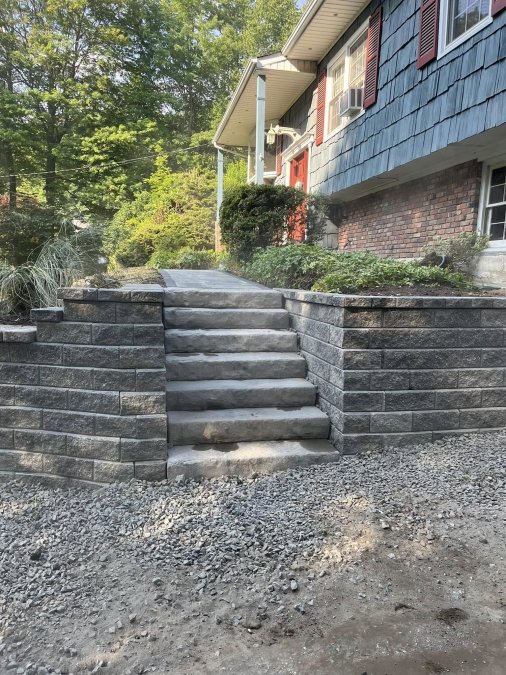
Work through it in order:
- Strip sod and topsoil first. Organic matter has no place under a patio.
- Remove large roots and debris that will rot and leave voids.
- Loosen compacted soil with a rototiller or spade so the base can bond.
- Dig to final depth, checking against a string line as you go.
Set aside clean topsoil for backfill around the edges. Haul the rest away. As a contractor, we'd rather over-dig by an inch than under-dig and fight settlement later.
Paver Base Depth for Stone Pavers: Matching the Base to the Load
Paver base depth for stone pavers depends on the load. A foot-traffic patio and a driveway carrying trucks are not the same job. Heavy pavers concentrate weight, so the aggregate base has to spread that load across stable subgrade.
A practical guide:
| Application | Base Depth | Notes |
|---|---|---|
| Foot-traffic patio | 4 to 6 inches | Compacted crushed gravel |
| Patio with heavy stone pavers | 6 to 8 inches | Deeper base for load spread |
| Driveway or vehicle area | 8 to 12 inches | Engineered for weight |
Build the base in lifts of about 2 to 3 inches and compact each lift. One thick loose layer will not compact evenly, and the soft spots show up as dips within a season.
Sand vs Gravel Base for Pavers: What Belongs Under Heavy Stone
Sand vs gravel base for pavers is not either-or. Gravel does the structural work and sand does the finishing work. Get the order wrong and the patio fails.
Here's how the layers stack:
- Subgrade: native soil, graded and compacted.
- Aggregate base: crushed gravel, compacted in lifts. This carries the load.
- Bedding sand: a thin layer of coarse washed sand, screeded level. This levels the pavers.
- Jointing sand: polymeric or regular sand swept into the joints.
Sand alone cannot support heavy stone pavers. It shifts, holds water, and pumps out under load. Gravel alone leaves a surface too rough to set pavers flat. You need both, in that order. For guidance on joint sand and stabilization, the Interlocking Concrete Pavement Institute publishes solid installation references.
Soil Compaction for Pavers: Equipment, Passes, and Verification
Soil compaction for pavers is where good intentions meet real equipment, and it is the step most DIY guides gloss over. A hand tamper works for small edges. For a full patio, you need a plate compactor, and you need to know how to run it.
Match the tool to the job:
- Hand tamper: tight corners, edges, and small repairs. Slow, but it reaches where a plate cannot.
- Plate compactor: the main base and subgrade. A forward plate in the 3,000 to 5,000 pound impact class handles most backyard patio work; a reversible plate is better on larger or heavier-load jobs.
- Jumping jack: deep subgrade in tight access, but it is too aggressive for bedding sand and can disturb a finished base.
Build the base in lifts of about 2 to 3 inches and compact each lift before adding the next. One thick loose layer will not compact evenly, and the soft spots show up as dips within a season. Run multiple passes over each lift, overlapping your path by about half the plate width, and change direction between passes so the material knits together.
Then verify. A simple check is to press a screwdriver into the compacted base. It should resist. If it sinks easily, keep compacting. On larger jobs, a contractor may use a proof-rolling pass with equipment weight to expose soft spots before the sand goes down. Another field check is to walk the base in a grid and listen for hollow spots, they signal loose material underneath.
As a contractor, we would rather over-compact than under-compact. Heavy stone pavers concentrate load, and a base that passes the screwdriver test on day one is the difference between a patio that holds and one that rocks. You Need Santini's when the compaction has to be right the first time.
Drainage Under Paver Patio: Slope, Fabric, and Water Management
Drainage under paver patio work is the step homeowners underestimate most. Water is what destroys bases. Get it moving and the patio lasts.
Three moves protect the install:
- Keep the slope: maintain that gentle fall from the house to the yard edge through every layer.
- Add geotextile fabric: a separation layer between subgrade and gravel stops fine soil from pumping up into the base.
- Plan an outlet: daylight the water to a lower area, a dry well, or a drainage channel, not against the foundation.
Geotextile fabric is cheap insurance. It keeps clay from migrating into clean gravel, which would otherwise clog the base and trap water. For properties with chronic drainage problems, we assess the whole yard, not just the patio footprint. Fixing the source beats patching the symptom.
Common Mistakes That Cause Settling and How to Avoid Them
Settling almost always traces back to a skipped step. Here's what we see most, and the fix for each:
| Mistake | Fix | Why It Matters |
|---|---|---|
| Leaving organic matter in the base | Strip all topsoil and roots | Decay leaves voids |
| One thick base lift | Compact in 2 to 3 inch lifts | Even compaction |
| No separation fabric | Add geotextile layer | Stops soil pumping |
| Filling low spots with loose soil | Use compacted gravel | Loose soil settles |
| Ignoring clay drainage | Test and plan outlet | Water destroys base |
One more: correcting low spots with loose soil instead of gravel. It looks fine on day one and sinks by the next wet season. Always backfill dips with compacted aggregate.
This is exactly the kind of issue we dig into upfront at Santini's Landscape, so bad soil and drainage surprises get handled before they balloon. We focus on one project at a time, which means your patio gets our full attention from excavation to final joint sand.
Preparing backyard soil for heavy stone pavers comes down to honest groundwork: test the soil, measure the slope, dig deep enough, and compact every layer. Skip a step and heavy pavers will expose it. If you'd rather hand the excavation, base, and drainage to a crew that does this every day, Santini's Landscape brings specialized equipment, premium materials, and workmanship we stand behind since 2004. Dreams Set in Stone. You Need Santini's. Request a free quote and let's build a patio that holds.
Frequently Asked Questions
How deep should you excavate for heavy stone pavers?
Excavation depth equals the paver thickness plus the bedding layer plus the compacted base, so the finished patio sits flush with surrounding grade. For heavy stone pavers, that usually means digging 8 to 12 inches below final grade, depending on paver thickness and base requirements. Add extra depth where you need to correct low spots or improve drainage. Measure against a string line or laser before you start removing soil, and check the depth again after compaction, since the base settles as it is worked.
Can you lay heavy stone pavers directly on soil or skip the gravel?
No. Soil alone cannot carry the load of heavy stone pavers, and sand alone shifts and migrates without a compacted aggregate base beneath it. A proper build uses a compacted crushed gravel base, a thin bedding layer of coarse washed sand, and jointing sand or polymeric sand in the joints. Skipping the gravel is the most common reason patios settle, rock, and crack within a couple of seasons. The base is what spreads the load, so it is not a step you can cut.
How do you improve drainage under a paver patio?
Start by measuring slope away from the house, typically a fall of about 2 percent, and grade the subgrade and base to match. Use a geotextile fabric between the subgrade and gravel to keep fine soil from migrating into the base. Where clay soil traps water, plan a discharge point, such as a French drain or dry well, before the base goes down. Compact in lifts and verify the slope with a level as you build, because drainage under a paver patio is set during excavation, not after the pavers are laid.
How do you compact soil before installing pavers?
Loosen and remove organic matter first, then compact the subgrade with a plate compactor in passes until it stops settling. Build the gravel base in lifts of about 2 to 3 inches and compact each lift, rather than dumping the full depth at once. Use a hand tamper in tight corners the plate compactor cannot reach. Verify compaction by checking for uniformity and re-checking the slope after each pass. Proper soil compaction for pavers is what prevents low spots and settlement once the stone goes down.