 blog
Best Natural Stone Types for Hudson Valley Climate
Table of Contents
- Why Natural Stone Choice Matters in the Hudson Valley
- Bluestone Patio Pros and Cons for Cold-Climate Yards
- Granite Pavers for Outdoor Use: Strength and Slip Resistance
- Fieldstone, Flagstone, Sandstone, and Limestone Compared
- Natural Stone Retaining Wall Materials That Hold Up
- Natural Stone vs Concrete Pavers: Which Wins Locally?
- Winter Care: Deicing Salt, Snow Removal, and Freeze-Thaw Protection
- Conclusion: Choosing the Right Stone for Your Project
- Frequently Asked Questions
Last Updated: October 17, 2026
Why Natural Stone Choice Matters in the Hudson Valley
Picking the best natural stone types for Hudson Valley climate starts with one hard fact: your patio will freeze and thaw dozens of times every winter. Water seeps into tiny pores, expands overnight, and pushes the stone apart. Choose the wrong material and you get hairline cracks by year three.
At Santini's Landscape, we've installed hardscape across Orange, Ulster, and Dutchess Counties since 2004, and we've watched which stones survive that cycle and which don't. This guide compares bluestone, granite, fieldstone, flagstone, sandstone, and limestone on durability, traction, and winter performance.
Natural stone is quarried rock cut or split for hardscape use, and its density and porosity decide how it handles frost. Dense, tight-grained stone sheds water. Porous stone soaks it up. That single difference drives most of what follows.
Here's the short version before we go material by material:
| Stone | Freeze-Thaw Resistance | Slip Resistance | Best Use |
|---|---|---|---|
| Bluestone | Excellent | Good when thermal-finished | Patios, walkways |
| Granite | Excellent | Good | Driveways, pool decks |
| Fieldstone | Excellent | Varies by face | Retaining walls |
| Flagstone | Good | Good | Walkways, rustic patios |
| Sandstone | Fair | Good | Low-traffic paths |
| Limestone | Fair | Moderate | Wall caps, accents |
Bluestone Patio Pros and Cons for Cold-Climate Yards
Bluestone is the local favorite for a reason: it's quarried in the region and handles freeze-thaw better than almost anything else in its class. The tight grain resists water absorption, so frost has less to grab onto.
Pros:
- Excellent cold-weather performance with minimal cracking
- Natural color variation from gray-blue to earthy brown
- Thermal finish adds grip for wet or icy conditions
- Regional sourcing keeps it a practical, familiar choice
Cons:
- Natural cleft surfaces can be uneven underfoot
- Color varies between pallets, so blending matters
- Heavier than some alternatives, which affects handling
A common mistake is choosing a smooth, polished bluestone for a shaded patio. It looks great until the first frost. We recommend a thermal or natural cleft finish for anything that stays wet, and we plan drainage slope into every bluestone patio we build.
Granite Pavers for Outdoor Use: Strength and Slip Resistance
Granite pavers for outdoor use win on pure toughness. Granite is one of the densest stones available, so it barely absorbs water and shrugs off freeze-thaw movement. For a driveway or a pool area, that strength is hard to beat.
The catch is traction. A polished granite surface turns slick when wet. Choose a flamed or bush-hammered finish instead, and granite delivers reliable grip plus decades of service.
What most guides miss is how granite behaves under load. Set on a proper compacted base, granite pavers resist shifting and settling better than softer stone, which is why we favor them for driveways and high-traffic paths. They cost more than concrete, but they don't chalk up or fade the way concrete can.
Fieldstone, Flagstone, Sandstone, and Limestone Compared
Fieldstone, flagstone, sandstone, and limestone often get grouped together because they share a rustic look, but they behave very differently under repeated freezing and thawing. The difference comes down to porosity and how the stone is cut, and that difference should drive where each one goes on a property.
Fieldstone is rounded stone gathered from fields and old walls. It is extremely durable in cold weather because most fieldstone in this region is dense granite, gneiss, or basalt that has already survived decades of frost. Its irregular shape demands a skilled hand to stack well, which is why we reserve it for retaining walls and accent boulders rather than flatwork.
Flagstone is a broad term for flat, split stone used in walkways and patios. Performance depends entirely on what the flagstone actually is. A dense sandstone flagstone set on a proper base performs well in freeze-thaw conditions, and its natural cleft gives good traction. A softer, more porous flagstone will absorb water and spall after a few winters. We always ask suppliers for absorption data before specifying flagstone for a main patio.
Sandstone and limestone are the softer options. Both absorb more water, so repeated freezing stresses them faster. Sandstone is essentially quartz grains cemented together, and the cementing minerals can break down under cyclic wetting and freezing. Limestone is calcium carbonate, which is susceptible to acid attack from deicers and acid rain, and it can pit and powder over time.
Here is how the four compare for the applications we install most often:
| Stone | Porosity | Freeze-Thaw Behavior | Best Application | Maintenance Reality |
|---|---|---|---|---|
| Fieldstone | Low to moderate (varies) | Excellent when dense; resists heave | Retaining walls, accent boulders | Minimal; repoint or restack as needed |
| Flagstone (dense) | Low to moderate | Good when set on proper base | Walkways, rustic patios | Occasional joint sand replenishment |
| Sandstone | Moderate to high | Fair; can spall under cyclic freezing | Low-traffic paths, wall caps | Sealing may help; monitor for flaking |
| Limestone | Moderate to high | Fair; susceptible to acid and frost | Wall caps, accents | Avoid acidic deicers; seal if used near walks |
The real difference between these stones comes down to porosity. Dense stone lasts; porous stone needs more care. When we specify any of these for a client, we match the stone to the exposure: full sun and good drainage forgive more porosity than a shaded, low spot that stays wet. Dreams Set in Stone means choosing the right stone for the right place, not just the one that looks best in a sample.
Natural Stone Retaining Wall Materials That Hold Up
Natural stone retaining wall materials fall into two camps: dry-stacked and mortared. Both hold up in this climate when built correctly, but they fail in different ways if they aren't.
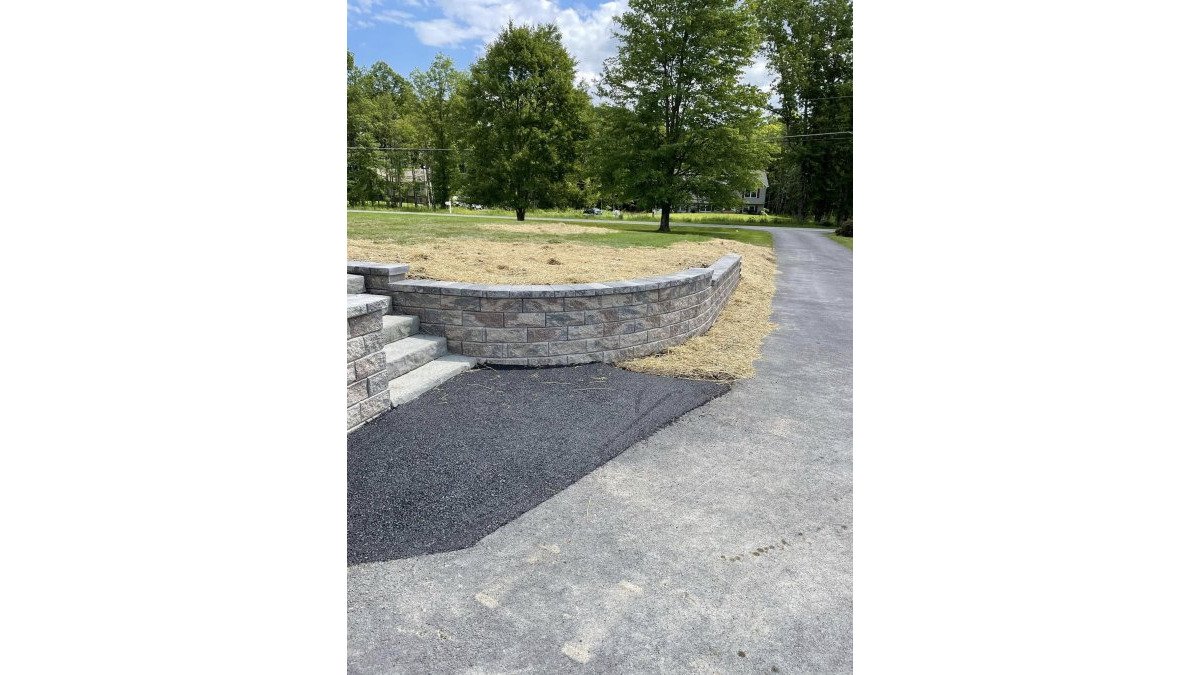
Dry-stacked walls rely on gravity and friction. Fieldstone and granite are the go-to choices because their weight and density resist frost heave. The key is drainage: gravel backfill and weep points let water escape instead of building pressure behind the wall.
Mortared stone walls use bluestone or granite veneer over a structural core. They look cleaner and more modern, but mortar joints can crack as the ground moves through freeze-thaw cycles. We build in movement joints and a drainage layer so the wall can flex without failing.
Natural Stone vs Concrete Pavers: Which Wins Locally?
Natural stone vs concrete pavers is the decision most homeowners actually face, so here's our honest take. Concrete pavers cost less up front and install fast. Natural stone lasts longer, looks better as it ages, and handles freeze-thaw with fewer surprises.
Concrete pavers can absorb water and spall, where the surface flakes off after repeated freezing. They also fade over time. Natural stone keeps its color and character, and a cracked stone can often be lifted and reset.
Where concrete wins is budget and speed. If you need a large area covered economically, concrete is a fair choice. But for a patio or walkway you want to last decades in this climate, natural stone is the better investment.
That's the theory. In practice, the gap comes down to installation quality. A well-built concrete patio beats a poorly built stone one every time. The material only reaches its potential when the crew gets the base, slope, and drainage right.
Winter Care: Deicing Salt, Snow Removal, and Freeze-Thaw Protection
Winter care is where most stone hardscape failures actually begin, and it is the topic most guides skip. Deicing salt, snow removal tools, and freeze-thaw cycles interact with stone in ways that depend on the specific material, the surface finish, and how the installation handles water. Here is how we think about it for the properties we maintain.
Deicing products and stone compatibility. Rock salt (sodium chloride) and calcium chloride are the most common deicers, and both can damage natural stone over time. Rock salt can pit and stain, and it accelerates surface breakdown on porous stones like limestone and sandstone. Calcium chloride is more aggressive and can leave a oily residue that attracts dirt.
Snow removal that protects the surface. Use a plastic shovel or a snow blower with a rubber edge. A metal blade scrapes and chips the stone surface, and those chips become weak points that frost exploits. On thermal-finished bluestone and flamed granite, a metal edge can leave scratch marks that are difficult to remove. On natural cleft surfaces, a metal edge can catch on the ridges and pop pieces loose.
Freeze-thaw protection comes down to drainage and installation. Water that sits is water that freezes. Clear snow before it melts and refreezes in the joints, and keep gutters and downspouts pointed away from the patio. But the more important protection is built in during installation: a properly compacted gravel base, a slight slope away from the house, and joint sand or polymeric sand that limits water infiltration.
What to watch for after each thaw. Walk the hardscape in late winter and look for rocking stones, open joints, and new cracks. A rocking stone means the base has settled or heaved, and it should be reset before the next freeze. Open joints should be refilled with joint sand before spring rains. Catching these early is far cheaper than replacing a section of patio later.
Conclusion: Choosing the Right Stone for Your Project
Every project here comes down to matching the stone to the job: bluestone and granite for patios and driveways, fieldstone for rustic walls, softer stone for accents and low-traffic areas. Get the material right, build the base right, and your hardscape will outlast the winters that test it.
That's where we come in. Santini's Landscape brings over two decades of local hardscape experience, premium materials, and a focus on finishing one project before starting the next. We handle excavation, site prep, drainage, and installation so your patio or wall is built to last.
Dreams Set in Stone. You Need Santini's. Request a free quote and let's build something that holds up for the long haul.
Frequently Asked Questions
Which natural stone handles freeze-thaw cycles best?
Bluestone and granite are the top performers in Hudson Valley freeze-thaw conditions. Both have low water absorption and dense grain structures that resist spalling and cracking. Fieldstone also performs well when properly installed with a free-draining base. The key is not just the stone itself but the installation: a compacted gravel base, geotextile fabric, and proper slope for drainage prevent water from pooling and expanding inside the stone pores during winter.
Is bluestone a good choice for patios in cold climates?
Yes, bluestone is one of the best natural stone options for cold-climate patios. Its tight grain and low porosity help it withstand repeated freezing and thawing. A bluestone patio also offers excellent slip resistance when finished with a thermal or natural cleft surface. The main drawbacks are higher material cost and color variation that some homeowners dislike. For Hudson Valley properties, bluestone has a long track record of durability through harsh winters.
How do you prevent natural stone from cracking in winter?
Preventing winter cracking starts with proper installation. Use a compacted base of at least 4 to 6 inches of crushed gravel, add a geotextile separator, and ensure the surface slopes away from structures at roughly 2 percent. Avoid deicing salts that contain chlorides, which can damage stone over time. Instead, use sand or a calcium magnesium acetate product. Also, keep snow removal tools like metal shovels from striking stone edges, and never chip ice with a sharp tool.
What natural stone is best for retaining walls?
For natural stone retaining wall materials, granite and fieldstone are the strongest choices. Granite offers high density and resistance to freeze-thaw damage, while fieldstone provides a rustic look and excellent structural integrity when dry-stacked or mortared. Both must be installed with proper drainage behind the wall, including gravel backfill and weep holes, to relieve water pressure. In the Hudson Valley, these materials are readily sourced and have proven performance in local soil conditions.