 blog
Fire Pit on Patio Cost: What Homeowners Should Budget
Last Updated: November 1, 2026
Quick Summary
The fire pit patio cost depends mainly on the existing patio surface, base preparation, fuel type, and custom stonework rather than the fire pit alone. Because every backyard differs, Santini's Landscape provides itemized estimates so homeowners can compare quotes fairly. Dreams Set in Stone, and that starts with an honest estimate.
- Site assessment checks the patio base, drainage, and clearance before any work begins.
- Gas units add fuel line costs, while wood-burning units add ash removal and chimney cleaning.
- Ask every contractor to show cost lines separately, along with assumed dimensions and materials.
- Built-in pits cost more and are harder to move than portable units.
- Custom stone work requires more skilled labor hours and typically extends the project timeline.
Table of Contents
- What Adding a Fire Pit to an Existing Patio Really Involves
- Itemized Cost Breakdown for a Fire Pit on an Existing Patio
- Gas vs Wood Burning Fire Pit Cost Compared
- Built-In Versus Portable Fire Pits: Which Makes Sense
- Custom Stone Fire Pit Installation: What Drives the Price
- Patio Renovation Project Timeline and Scope Planning
- Planning Your Fire Pit Project With Santini's
- Frequently Asked Questions
Adding a fire pit to an existing patio is one of the most popular outdoor upgrades, and it is also one of the easiest to misjudge on budget, so understanding the fire pit patio cost before breaking ground matters. At Santini's Landscape, we install fire pits on existing patios for homeowners in the Hudson Valley. Our approach is simple: one project at a time, premium materials, and a clear picture of what the work will cost before we break ground. Dreams Set in Stone, and that starts with an honest estimate.
A fire pit is a contained, built or placed feature that burns wood or gas for warmth and gathering. On an existing patio, the real cost is rarely just the fire pit itself. It includes site work, base preparation, fuel line or fuel storage decisions, and finish restoration.
What Adding a Fire Pit to an Existing Patio Really Involves
Most people picture a fire pit sitting on top of a finished patio. In practice, the patio surface has to be evaluated first. Pavers, stamped concrete, and poured slabs each handle heat, weight, and thermal movement differently. A patio built for dining furniture is not automatically built for a heavy masonry ring or a gas burner.
The work usually falls into four stages: assessing the existing surface, cutting and preparing an opening or pad, installing the fire pit structure, and restoring the surrounding patio. Each stage carries labor and material costs. Skipping the assessment is the most common reason a budget grows after the job starts.
Itemized Cost Breakdown for a Fire Pit on an Existing Patio
Most people picture a fire pit sitting on top of a finished patio. In practice, the patio surface has to be evaluated first. Pavers, stamped concrete, and poured slabs each handle heat, weight, and thermal movement differently. A patio built for dining furniture is not automatically built for a heavy masonry ring or a gas burner.
The work usually falls into four stages: assessing the existing surface, cutting and preparing an opening or pad, installing the fire pit structure, and restoring the surrounding patio. Each stage carries labor and material costs. Skipping the assessment is the most common reason a budget grows after the job starts.
Because every backyard is different, we do not publish flat prices here. Instead, the categories below show what a transparent estimate should include, so you can compare quotes on equal terms. For each line, we explain what drives the cost up or down, and we note the assumptions a contractor should state explicitly.
- Site assessment and layout: checking the patio's base, drainage, and clearance from structures and plantings. Cost drivers: accessibility, slope, and whether the patio is on grade or elevated. A thorough assessment may include a probe of the base material and a moisture check.
- Demolition and cutting: removing or cutting pavers or slab to create a clean footprint. Cost drivers: material type (pavers are easier to lift and reset; stamped concrete may require saw-cutting and patching), and whether the cut area is visible or can be hidden under the fire pit's footprint.
- Base preparation: compacted gravel or a reinforced pad to support the fire pit's weight. Cost drivers: soil conditions, required depth, and whether a concrete collar is needed for a masonry pit. For gas units, this stage also includes trenching for the fuel line.
- Fire pit materials: stone, block, or a manufactured insert, plus mortar and sealers. Cost drivers: stone type (cast stone vs. natural stone vs. brick), complexity of the design (straight vs. curved walls), and whether a steel or refractory insert is required for wood-burning units.
- Fuel line or fuel storage: for gas units, the run from the supply source; for wood units, a dry storage plan. Cost drivers: distance from the gas meter or propane tank, whether the line must be buried or can be run above grade, and whether a shutoff valve is required at the pit.
- Labor: crew time for demolition, construction, and restoration. Cost drivers: crew size, skill level (masons vs. general laborers), and the number of days on site. Custom stonework typically requires more skilled labor hours than a kit-built unit.
- Restoration: re-setting pavers, matching joint sand, and cleanup. Cost drivers: whether matching pavers are available, the condition of adjacent materials, and whether the patio needs re-sanding or sealing after the work.
Ask every contractor to show these lines separately. A single lump sum makes it hard to see where the money goes and harder to compare bids.
Our crews work on one project at a time, so we can give you a realistic schedule along with the estimate. Dreams Set in Stone means every line item is accounted for before we start.
Gas vs Wood Burning Fire Pit Cost Compared
Gas and wood-burning fire pits cost differently over time, not just at installation. Your actual costs will depend on labor rates, fuel prices, and site conditions.
| Factor | Gas (Natural Gas or Propane) | Wood-Burning |
|---|---|---|
| Upfront installation | Higher: requires fuel line, connection, and possibly inspection. Propane may need a tank and delivery setup. | Lower: no fuel line, but may require a chimney or spark screen and a refractory insert. |
| Fuel cost | Ongoing utility or propane cost; predictable per use. | Firewood purchases or labor to split and store; variable with market prices. |
| Maintenance | Periodic burner and valve service; cleaning of lava rock or glass media. | Ash removal after each use; annual chimney or flue cleaning; masonry inspection. |
| Convenience | Instant on/off; no ash, sparks, or smoke. | Requires starting a fire, managing logs, and waiting for cooldown. |
| Lifespan | Burner components may need replacement after several years; masonry structure lasts decades. | Masonry structure lasts decades; firebox may need repointing over time. |
| Safety and code | Must follow gas line codes and clearance requirements; may require permit and inspection. | Must follow local burn ordinances and clearance to combustibles; spark arrestor may be required. |
Neither option is universally cheaper. The right choice depends on how often you will use the fire pit, whether you already have a gas supply nearby, and how much maintenance you want to manage.
Fuel Type Long-Term Cost of Ownership
Long-term cost goes beyond installation. For a gas fire pit, the ongoing expense is the fuel itself, which depends on usage and your utility rate. For a wood-burning pit, the expense is firewood, storage space, and periodic cleaning. Frequent users may find that one option costs noticeably more over several seasons, even if its installation was less expensive.
Repairs also differ. Gas burners and valves may need servicing, while wood pits mainly need cleaning and occasional masonry repair. Asking a contractor to estimate both upfront and ongoing costs gives you a more complete comparison.
You Need Santini's to help you weigh these trade-offs against your actual usage and site conditions. Dreams Set in Stone means we design for how you live, not just for the install day.
Built-In Versus Portable Fire Pits: Which Makes Sense
A built-in fire pit becomes a permanent part of the patio. It offers the cleanest look and integrates with seating walls and surrounding hardscape, but it is the most expensive to install and the hardest to move. A portable fire pit costs less up front, can move with you, and requires no permanent excavation, though it still needs a safe, level surface.
If you plan to stay in your home for many years and want the fire pit to anchor the space, built-in is usually the better investment. If you rent, expect to move, or want flexibility, a portable unit may fit better. Either way, make sure the surface can handle the heat and weight.
Custom Stone Fire Pit Installation: What Drives the Price
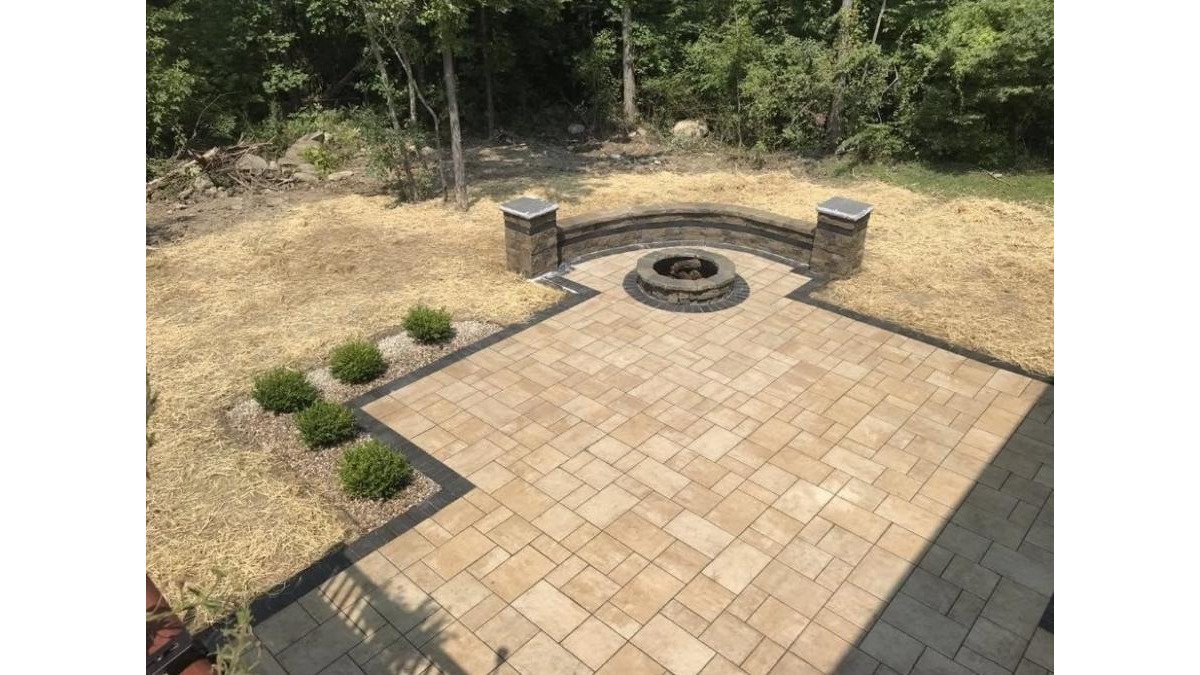
A custom stone fire pit is often the most visually striking option and the most labor-intensive. Explore our landscaping services to see how a custom stone installation fits your property. The price is driven by the stone itself, the amount of hand-fitting required, the complexity of the design, and whether seating or other features are included.
Custom work also takes longer, which affects labor cost. The best way to control the budget is to decide early which details matter most.
Patio Renovation Project Timeline and Scope Planning
Adding a fire pit to an existing patio is often part of a larger renovation. Planning the full scope early prevents rework. If the patio base is already settling or cracking, it is better to correct that before placing a heavy fire pit on top of it. Proper base preparation protects the patio and the fire pit over the long run. Learn more about protecting a patio base from settling and cracking.
Timelines vary with weather, material lead times, and the size of the project. Curing, restoration, and inspections can extend the schedule. Plan around the seasons, since masonry work is weather-dependent in the Hudson Valley.
Planning Your Fire Pit Project With Santini's
The best next step is a conversation about your space. Tell us what you want to gather around, how you plan to use the fire pit, and what your current patio looks like.
Ready to get started? Request a free quote from Santini's Landscape and let's begin planning your outdoor space. Dreams Set in Stone, and You Need Santini's.
Frequently Asked Questions
How much does it cost to add a fire pit to an existing patio?
The cost depends on the fire pit type, fuel source, site conditions, and how much of the existing patio must be cut, excavated, or rebuilt. Santini's does not publish standard prices because every site is different. Pricing depends on the design, materials, utility work, and access to the space. The most accurate way to understand your number is to request a free quote after a site visit, where the crew can review the patio surface, drainage, and where the fire pit will sit relative to structures and seating.
Is a gas or wood burning fire pit cheaper to install?
Installation cost differs mainly because gas fire pits need a gas line, a connection by a licensed professional, and a permit where required, while wood burning pits need a sound base, clearances, and a proper chimney or open design. Wood burning units often have lower upfront equipment cost but ongoing fuel and cleanup time. Gas units cost more to connect but offer lower daily operating effort.
How much space does a patio fire pit need?
Most patio fire pit designs need enough clearance from seating, overhanging structures, and fences to keep the heat and flames at a safe distance. The surface beneath the pit should be noncombustible and level. Patio size matters as much as the pit itself, since a small patio may leave little room for seating around the fire.
What makes a custom stone fire pit more expensive than a prefab unit?
A custom stone fire pit typically costs more because it requires material selection, stone cutting, skilled masonry, and additional labor hours compared with a prefabricated kit. Custom work also allows you to match the patio pavers or existing hardscape, which adds design value. The final cost depends on the stone, size, and complexity of the design.