 How-to
10 Questions to Ask a Snow Plowing Contractor
Quick Summary
To vet a snow plowing contractor, ask about storm response, equipment and backup plans, insurance, and contract terms before signing. Get the trigger depth, response window, and included surfaces in writing so every bid can be compared line by line.
- Ask the exact snowfall depth that triggers service and the response window after a storm starts.
- Confirm how many trucks and crew members serve your property, and what happens if equipment fails.
- Request certificates of general liability and workers' compensation insurance before the season starts.
- Get trigger depth, excluded surfaces, ice management, and hauling terms written into the contract.
- Compare bids on one worksheet, since the lowest total is rarely the lowest real cost.
Table of Contents
- Why the Right Snow Plowing Contractor Matters for Your Property
- Questions About Availability and 24/7 Storm Response
- Questions About Equipment, Crew Size, and Backup Plans
- Questions to Ask a Snow Plowing Company About Insurance and Property Protection
- Snow Removal Contract Terms That Protect Your Property
- How to Compare Bids Apples-to-Apples
- Snow Plowing Contractor Checklist and Printable Question List
- Scheduling Your Site Assessment and Requesting a Free Quote from Santini's
- Frequently Asked Questions
Why the Right Snow Plowing Contractor Matters for Your Property
Choosing a snow plowing contractor is one of the most important seasonal decisions a property owner makes. A late plow, a missed storm, or a poorly cleared lot can create slip hazards, block access, and damage landscaping. A smoother winter starts when the right partner is in place before the first flake falls.
Many property owners choose a contractor based on price alone. That approach often backfires. The cheapest bid may not include 24/7 storm response, adequate equipment, or proper insurance, and those gaps tend to show up at the worst possible moment.
Before you sign anything, a few questions can reveal how a company really operates. Below, we walk through 10 questions to ask a snow plowing contractor, along with what good answers sound like and what should raise a red flag.
Watch out: A contractor who promises to "plow whenever needed" without defining a snowfall trigger or response window has not clearly defined the service.
Questions About Availability and 24/7 Storm Response
Storm timing decides whether a property stays safe. Ask every contractor how quickly they begin service once snow reaches a set depth, and whether they operate overnight and on weekends.
Good questions to ask:
- What snowfall depth triggers service on my property?
- How many hours after a storm begins do you typically start plowing?
- Do you monitor storms overnight, and who is on call?
- Can you provide a written service-level expectation for response time?
A reliable company answers with specifics. Vague replies like "we're always available" should prompt a follow-up. You can read more about how emergency coverage works for residential properties in our guide to emergency snow removal services for residential properties, and you can review our full snow removal service scope before comparing providers.
Questions About Equipment, Crew Size, and Backup Plans
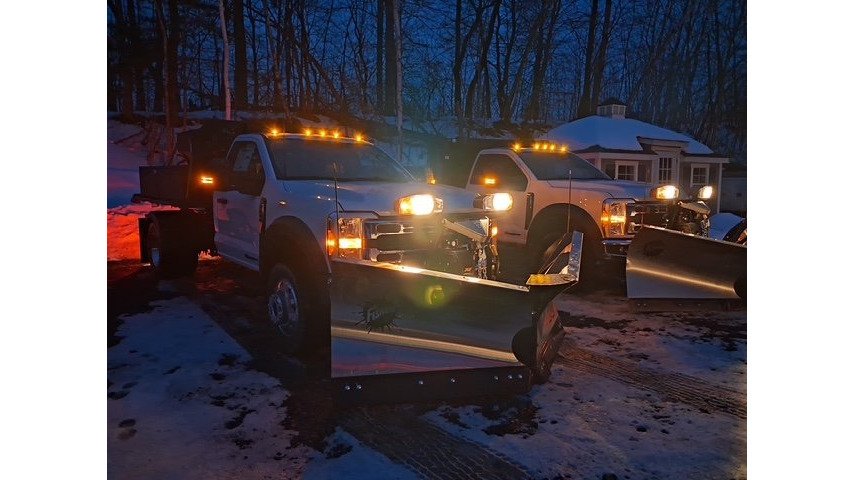
Equipment failures happen. A contractor with one plow truck and no backup can leave your lot unserviced for hours during a major storm. Ask about the size of the crew, the type and number of trucks and loaders, and what happens when a machine breaks down.
!A crew of workers in high-visibility jackets beside a plow truck in a snowy commercial parking lot, early morning light
Key points to clarify:
- How many plow trucks and loaders are assigned to my property?
- Do you own your equipment, or do you rely on subcontractors?
- What is your backup plan if a truck fails mid-storm?
- How many crew members are trained to operate each machine?
Ask whether equipment is dedicated to your account or shared across several clients. Shared equipment can mean your property waits its turn.
Questions to Ask a Snow Plowing Company About Insurance and Property Protection
Insurance protects you if something goes wrong on your property. A plow blade that cracks a light pole or a slip-and-fall claim can become expensive quickly if the contractor is underinsured.
Ask for proof, not just a verbal assurance:
- Do you carry general liability insurance, and what are the coverage limits?
- Do you carry workers' compensation for your crew?
- Will you provide a certificate of insurance naming my property?
- Are your subcontractors insured as well?
Request certificates before the season starts, and keep copies on file. A contractor who hesitates to provide them is telling you something.
Snow Removal Contract Terms That Protect Your Property
A written contract turns verbal promises into enforceable commitments, but only if you read it the way a contractor does. Disputes often stem from terms that were never defined.
Trigger depth and service timing. The contract should state the exact snowfall depth that activates service. Confirm whether the trigger is measured at a fixed location, who measures it, and whether service begins during the storm or only after accumulation stops.
Service limits and exclusions. Every contract has boundaries. Look for language on:
- Maximum number of service visits per event or per season
- Whether hauling, stacking, or relocating snow off-site is included or billed separately
- Surfaces excluded from service, such as gravel lots, decorative pavers, or roof areas
- Whether ice management is included or a separate line item
- What happens during a declared state of emergency or a storm exceeding a stated accumulation threshold
Renewal and escalation terms. Some snow contracts auto-renew unless you give written notice before the season, so check the notice window. Check the notice window and whether the renewal locks in the prior season's scope or allows the contractor to adjust pricing or service levels.
Cancellation and suspension clauses. Confirm how either party can cancel, what notice is required, and whether cancellation mid-season triggers a penalty or forfeits prepaid amounts. If your property changes hands or a tenant vacates, you want to know your exit options before winter starts.
Documentation and proof of service. The contract should specify how service is recorded, time-stamped logs, photos, GPS tracking, or signed tickets, and how quickly those records are available to you. This matters when a slip-and-fall claim or a billing dispute arises months later.
Watch out: A contract that references "industry-standard service" or "typical response" without a defined trigger, window, or measurement method leaves you with no way to prove a missed service.
Our team recommends building a one-page scope-of-work checklist that mirrors the contract. List every surface, every service, and every response expectation, then confirm the contract matches it word for word. When we plan winter service for a property, we treat that checklist as the controlling document.
How to Compare Bids Apples-to-Apples
Bids often look different on paper even when they describe similar work, and the lowest number is rarely the lowest total cost. The reliable method is to normalize every bid against the same worksheet before you compare totals. Here is how to do it.
Step 1: Separate the pricing models. Snow contracts generally fall into three structures, and mixing them in one comparison distorts the result:
- Seasonal (fixed) pricing, one flat amount for the season regardless of snowfall. Predictable for budgeting, but you pay the same in a light winter as a heavy one.
- Per-event (per-push) pricing, a set amount each time the trigger depth is reached. Costs scale with snowfall, so a heavy season can exceed a seasonal bid.
- Per-hour or time-and-materials pricing, billed for actual equipment and labor time. Common for hauling, ice management, and unusual conditions.
Put each bid's model in its own column. A seasonal bid and a per-push bid cannot be compared until you estimate the number of events a typical winter brings to your site.
Step 2: Build a line-item worksheet. For every bid, record the same fields side by side:
| Bid Factor | What to Record | Why It Matters |
|---|---|---|
| Pricing model | Seasonal, per-event, or hourly | Determines how total cost behaves across the season |
| Trigger depth | Exact inches stated | Sets how often you are billed |
| Included surfaces | Parking, walks, entrances, pads | Prevents paying twice for missed zones |
| Ice management | Included or separate rate | A common hidden add-on |
| Hauling and stacking | Included or billed per load | Can rival plowing cost on tight sites |
| Response window | Written hours after trigger | Defines service level, not just price |
| Equipment commitment | Dedicated or shared | Affects reliability in a major storm |
| Insurance limits | General liability and workers' comp amounts | Protects you against claims |
| Contract term | Start, end, renewal notice | Prevents auto-renewal surprises |
| Documentation | Logs, photos, GPS, tickets | Your evidence in a dispute |
Step 3: Identify hidden charges. Ask each contractor directly whether the following are included or billed separately: salting and de-icing materials, refills after the initial application, snow hauling, loader time, standby charges during a storm warning, fuel surcharges, and after-hours call-out fees. A bid that omits these is not cheaper, it is incomplete.
Step 4: Score service level, not just price. Two bids with the same total can differ sharply in response window, equipment dedication, and documentation. Weight those factors explicitly. A per-push bid with a four-hour response and dedicated equipment may serve your property better than a seasonal bid with shared trucks and no written window.
Watch out: A bid that quotes a single seasonal number without listing trigger depth, included surfaces, and ice management scope cannot be compared to any other bid, ask for the missing line items in writing before you decide.
A winter service plan works best when the worksheet is built with the property owner so every line is visible before signing. Dreams Set in Stone, and You Need Santini's.
Snow Plowing Contractor Checklist and Printable Question List
Use this checklist when you meet with each contractor. Print it, bring it to every site visit, and mark the answers as you go.
- What snowfall depth triggers service?
- What is your response time after a storm starts?
- Is service available 24/7 during storm season?
- How many trucks and crew members will serve my property?
- What is your backup plan if equipment fails?
- Do you carry general liability and workers' compensation insurance?
- Can you provide certificates of insurance?
- Are the service areas and surfaces listed in writing?
- How is salting and de-icing handled?
- Is pricing seasonal or per event?
- How is service documented after each storm?
- What are the cancellation and payment terms?
Note the answers next to each question for every bid. Patterns in vague or missing answers often separate a dependable partner from a risky one.
Scheduling Your Site Assessment and Requesting a Free Quote from Santini's
A site assessment is a good way to get accurate answers. It lets a contractor walk the property, note the areas that need service, identify drainage and access concerns, and recommend a plan that fits the site.
Ready to talk through your property? Reach out to schedule an excavation consultation or request a free quote from our contact page. Winter service plans, like outdoor spaces, benefit from careful planning and attention to detail. Dreams Set in Stone, and You Need Santini's.
Frequently Asked Questions
How much does a snow plowing contractor charge?
Snow plowing pricing usually depends on property size, the number of service areas, how often the site needs service, and whether the contract is seasonal or per event. Because these factors vary from property to property, the most reliable way to get an accurate number is a site assessment. Ask each contractor to price the same scope of work, including service frequency, storm trigger depth, and ice management, so you can compare bids on equal terms. For current pricing and a quote specific to your property, request a free quote from Santini's.
What should a snow plowing contract include?
A solid snow plowing contract should describe the service area with a site plan, the snowfall depth that triggers service, the expected response time after a storm ends, and whether salting or de-icing is included. It should also state how service is documented, such as service logs or proof of service, along with insurance requirements, payment terms, and the process for handling disputes after a storm. Reviewing these terms before signing helps prevent misunderstandings during the busiest weeks of winter.
What insurance should a snow plowing contractor carry?
Ask for a certificate of insurance that shows general liability coverage and the policy limits, along with workers' compensation if the contractor has employees. Also ask whether the contractor carries commercial auto coverage for plow trucks, since plowing involves vehicles operating close to buildings, vehicles, and pedestrians. Confirm that the certificate names your property as an additional insured where appropriate, and request an updated certificate each season.
When should a snow plowing contractor start service?
Most contracts tie service to a snowfall trigger depth, meaning the contractor begins work once accumulation reaches a stated level. Ask what that trigger is, whether it applies to every event, and how the contractor monitors conditions overnight and on weekends. Clarify how quickly crews will be on site after the trigger is met, since response time is one of the most important measurable standards in a contract.